Picture a Thursday afternoon.
The new branch opens on Sunday. Before leaving the office, the Head of Operations sends Finance an Excel file titled “ERP Access Required.”
There are 27 names on it.
Eight people will enter sales orders. Six will receive and transfer stock. Four will approve purchases. Three will handle accounts. The rest are managers who need to see what is happening without waiting for a weekly report.
No one has asked for a new ERP module. No one has requested a new integration. They simply need access to the system the company already uses.
Then the CFO asks a question that changes the meeting:
“If we already paid for the ERP, why does adding employees create another software bill?”
That question sits at the centre of the ERP cost-per-user debate.
Choosing an ERP pricing model is not a decision a business can afford to make from the first quotation alone. The lowest price today can become the highest cost tomorrow if the team grows, more departments need access, or new branches enter the operation.
That is why this comparison will go beyond licence fees. We will examine users, business growth, implementation, support, expansion, and long-term ownership cost to determine which model is truly built for a growing business in Bangladesh.
ERP Cost Per User Is Not the Same as ERP Ownership Cost
ERP cost per user is the recurring licence or subscription amount attached to each paid user account. If the number of paid users increases, the software bill generally increases too.
But the licence is only one part of the money an ERP consumes.
A proper ERP total cost of ownership calculation should also include:
- Implementation and process mapping
- Data preparation and migration
- Configuration and customisation
- Training and change management
- Hosting and infrastructure
- Support and maintenance
- New branches, warehouses, outlets, or legal entities
- Additional modules and integrations
- Internal work that continues outside the ERP
The cheapest licence can therefore produce the more expensive operating model. The reverse can also be true: a large upfront investment can be wasteful if the company never adopts the system fully.
The decision is not simply subscription versus perpetual. It is about what the business pays, what the contract includes, and what happens when the organisation changes.
First, Separate Two Questions Buyers Often Mix
When an ERP proposal says “subscription” or “perpetual,” it answers only one part of the commercial question.
| Question | Common options | Why it matters |
| How long does the software right last? | Subscription term or perpetual licence | Determines whether the core software right expires |
| What makes the price change? | Users, modules, outlets, entities, transactions, implementation scope, or a hybrid | Determines what growth will cost |
A perpetual licence can still be priced per user. A subscription can be priced at a flat company rate. A one-time licence may still require recurring hosting, support, or service payments.
This is why the word perpetual does not automatically mean “pay once and never pay again.” It means the licence itself does not expire. The signed agreement still decides what is paid for implementation, service, hosting, support, expansion, and change requests.
How User-Based ERP Pricing Works
Under a user-based ERP pricing model, the basic calculation is simple:
Paid Users × Price Per User × Subscription Period
To understand how this works in practice, consider Odoo, one of the most widely recognised global ERP platforms.
Odoo’s official pricing presents its paid plans on a per-user, per-month basis. Its user documentation explains that adding internal users can automatically update a monthly subscription or create an upsell quotation for an annual or multi-year plan.
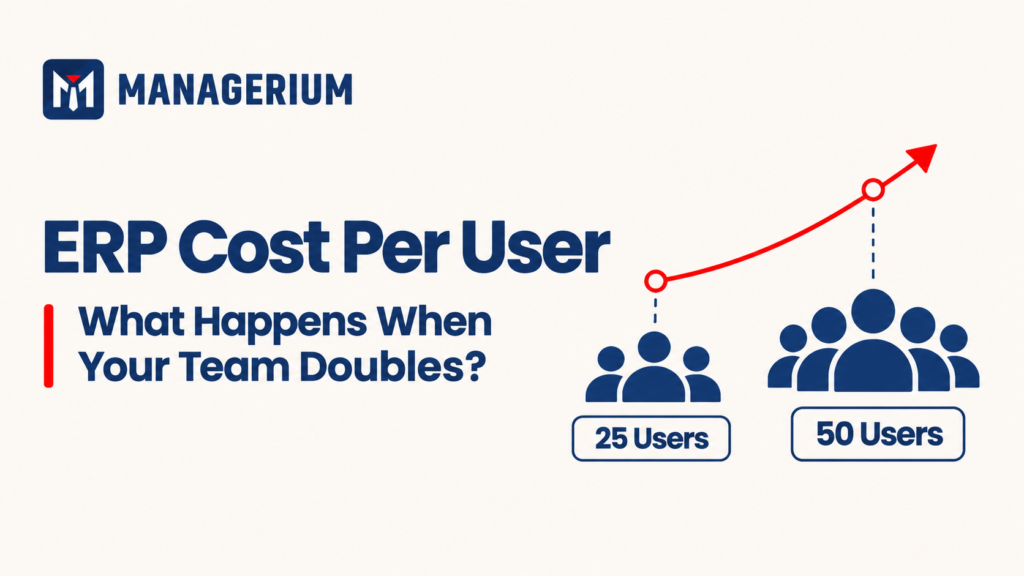
Suppose a company starts with 25 Odoo users. A year later, Sales, Procurement, Warehouse, and Management also need access, taking the total to 50 users. The business may still be using the same modules and workflows, but its recurring subscription can increase because more employees now need to work inside the ERP.
That is the central characteristic of user-based pricing: as the number of paid users grows, the recurring software cost can grow with it.
This model has real advantages:
- A smaller team can start with a lower initial licence commitment.
- Monthly or annual budgeting is straightforward when user count is stable.
- The business can add access gradually instead of buying for future scale on day one.
- Standard cloud hosting, updates, and support may be included, depending on the plan.
- Different user types may reduce the cost of employees who only need limited access.
For a 10-person company that is still testing its processes, this flexibility can be more valuable than owning a perpetual licence.
The pressure appears when ERP adoption succeeds. The more the business moves into the system, the more paid users it may create.
When ERP Adoption Becomes a Billable Event
Most ERP projects do not remain inside Accounts.
Once the system begins working, other teams need to participate. Sales needs to enter orders. Procurement needs to create and approve purchase requests. Warehouse teams need to receive, transfer, and adjust stock. Finance needs the transactions to appear without being entered again. Managers need dashboards and approval access.
That is a good sign. It means the ERP is becoming part of the operating model.
Under per-user pricing, however, successful adoption can also increase the recurring bill. The company pays more not necessarily because the software gained a new capability, but because more employees are completing their responsibilities inside it.
The model is commercially valid. But for the buyer, it creates an uncomfortable cost curve: the software can become more expensive precisely because more employees are finally using it properly.
The relevant question is not:
“How many ERP users do we have now?”
It is:
“How many people must work inside the ERP if we want the process to function properly?”
The Hidden Cost Begins When Management Limits Access
Return to the new branch.
Finance approves only eight of the 27 requested accounts to control the licence bill. Everyone else must send information to those eight people.
At first, the workaround feels harmless.
Sales sends orders through WhatsApp. The warehouse maintains a separate stock sheet. Purchase requests wait in email. One accounts executive enters several teams’ transactions at the end of the day.
Within a few months, the company has three versions of the truth:
- What happened in the operation
- What employees recorded in spreadsheets and messages
- What finally reached the ERP
The software bill remains controlled. The operating cost does not.
Transactions are entered late. Employees repeat the same work. Reports show when data was typed, not when the business activity occurred. Shared accounts weaken accountability. Approvals depend on a few licensed operators. Managers start asking people for updates instead of trusting the dashboard.
The company may save the price of a user licence while losing more through delay, rework, and poor visibility.
That leads to a better commercial question:
“What will it cost if the right employee cannot complete the work inside the ERP?”
How Scope-Based Perpetual Pricing Works
Now consider the same business growth under a scope-based perpetual model.
In Bangladesh, Managerium ERP is one example of this approach. Instead of making every internal user the primary recurring licence multiplier, the commercial proposal can be built around the agreed business scope, including:
- Required modules and workflows
- Branches, warehouses, outlets, or entities
- Approval levels and user roles
- Reports and dashboards
- Data migration and training
- Integrations and custom requirements
- Implementation effort and deployment support
The business pays an initial amount for the perpetual licence and implementation, while an ongoing service charge may still apply.
The initial investment can be higher. But if the modules, workflows, locations, and other agreed requirements remain unchanged, adding more employees within that scope does not have to create a new recurring licence cost for every user.
This changes the financial question from:
“How many employees need access?”
to:
“Has the actual scope of the business changed?”
However, scope-based does not mean unlimited.
A new branch, legal entity, module, integration, report, training requirement, or custom workflow may require a revised quotation. The contract must define those boundaries clearly. Without that clarity, “scope-based” can become another vague label.
Put Three Years of Growth Into the Calculation
Consider a hypothetical company that starts with 25 ERP users, grows to 50 users in year two, and reaches 75 users in year three.
The same modules are used throughout. No new branch, integration, or custom development is added. Both options receive comparable implementation and service.
The figures below are illustrative only. They are not current quotations from Odoo, Managerium, or any other vendor. Use the table as a calculation method, not as a vendor price comparison.
| Three-year cost item | User-based subscription | Scope-based perpetual model |
| User growth | 25 users in year 1, 50 in year 2, 75 in year 3 | Same user growth within the agreed scope |
| Licence or subscription | BDT 5,000 × 1,800 user-months = BDT 9,000,000 | Included in the one-time package below |
| Licence and implementation package | Implementation: BDT 800,000 | One-time licence and implementation: BDT 3,200,000 |
| Recurring service | Included in this illustration | BDT 60,000 × 36 months = BDT 2,160,000 |
| Three-year total | BDT 9,800,000 | BDT 5,360,000 |
In this scenario, the scope-based model becomes less expensive at approximately month 21. By the end of year three, it is not marginally cheaper. The difference is BDT 4,440,000, or BDT 44.4 lakh.
That result does not prove that perpetual licensing always costs less. Change any assumption and the answer can change.
- If the team stays at 25 users, the gap narrows significantly.
- If the subscription includes services that the perpetual proposal charges separately, the comparison changes.
- If new branches or modules expand the perpetual scope, the cost rises.
- If a foreign-currency subscription changes with exchange rates, the BDT cost can move even when the user count does not.
- If the company fails to implement or adopt either system, both options become expensive.
The point is not to force every business toward the same answer. It is to reveal the cost curve.
A pricing model does not win because its opening quotation is lower. It wins when the business can grow without repeatedly paying for the same people to participate in the same system.
Test the Calculation With Your Own Growth Plan
Before accepting any ERP quotation, write down three numbers:
- How many employees need ERP access today?
- How many will need access after three years?
- How many branches, outlets, or warehouses will the business add?
Then ask both vendors to calculate the complete 36-month cost against the same growth assumptions. This removes the sales language and exposes what each model will actually cost when the business expands.
Which ERP Pricing Model Survives Growth Better?
| Business situation | User-based subscription may fit better | Scope-based perpetual may fit better |
| Example used in this article | Odoo’s paid subscription model | Managerium ERP’s perpetual model |
| Team size | Small or stable | Expected to grow across departments |
| Upfront budget | Limited | Able to invest more initially |
| Process certainty | Still testing workflows | Core workflows are understood |
| ERP participation | A few power users | Many transaction owners and approvers |
| Expansion plan | Uncertain or short-term | Clear multi-year growth plan |
| Commercial priority | Flexibility and low entry cost | Cost predictability and wider adoption |
| Internal capability | Wants a standardised cloud product | Needs local process mapping and implementation support |
A subscription is not automatically a poor decision. For a small or stable team, it may remain the cleaner choice.
But a business planning to expand should be sceptical of any model that makes employee participation the permanent meter on its ERP bill.
Why the Bangladesh Business Context Tilts the Decision
For a growing business in Bangladesh, the pricing comparison should go beyond the licence line.
1. ERP Participation Often Expands by Function, Not Only by Headcount
A business may begin with Accounts and Inventory, then add Sales, Procurement, Production, HR, VAT, field operations, and management approvals.
Even if total headcount grows slowly, the number of employees who need ERP access can rise quickly.
2. Local Workflows Can Change the Implementation Scope
VAT processes, approval hierarchies, branch operations, warehouse transfers, local reporting, and industry-specific exceptions may require configuration or integration.
The National Board of Revenue maintains an official list of enlisted software firms, but enlistment alone does not prove that a solution fits every operational requirement.
Buyers still need to verify the exact workflow, forms, integration, and support included in the proposal.
3. Data Migration and Training Deserve Their Own Budget
An ERP does not become useful because the licence has been activated.
Existing item masters, customer records, supplier balances, opening stock, chart of accounts, and approval rules must be cleaned and moved. Employees must learn the new workflow.
Even Odoo’s own implementation guidance separates software subscription from work such as business analysis, configuration, key-user coaching, data import, and workflow customisation.
4. Support Accountability Matters After Go-Live
When a stock, finance, VAT, or integration issue crosses multiple parties, the buyer needs to know who owns the resolution.
A low software rate does not help if the internal team spends days coordinating among the software vendor, implementation partner, hosting provider, and third-party module developer.
5. Foreign-Currency Pricing Adds Another Variable
If the ERP subscription, hosting, implementation, or add-ons are billed in foreign currency, calculate the three-year cost in BDT under more than one exchange-rate assumption.
The user count may remain unchanged while the local-currency bill moves.
For a Bangladeshi company, local fit is not a patriotic preference. It is a cost, implementation, currency, and accountability question.
A globally familiar brand may still be the right choice, but familiarity does not cancel the economics of user growth.
Key Takeaways
- ERP cost per user is only one part of the bill. Total ownership cost also includes implementation, data migration, training, hosting, support, new branches and the manual work that stays outside the ERP.
- User-based pricing grows with adoption. As more teams start working in the ERP, the recurring bill rises. Limiting access to save on licences pushes work into spreadsheets and WhatsApp, which costs more in delays, rework and poor visibility.
- A perpetual licence still has recurring costs. The licence itself does not expire, but service, hosting, support and new scope can still cost money. The signed contract decides what is included.
- Growth changes which model costs less. In an example where a team grows from 25 to 75 users over three years, the scope-based perpetual model costs BDT 44.4 lakh less and pulls ahead around month 21. Different growth, scope or currency assumptions can change that result.
- Scope-based perpetual pricing fits a growing Bangladeshi business better. A small team that expects to stay the same size may do better with a user-based subscription. A growing business should compare the full 36-month cost of each option using the same growth plan. It should also sign only if the contract says adding users within the agreed scope will not bring new seat charges.
The Contract Question That Reveals the Real Pricing Model
Before signing, ask every ERP provider to answer this in writing:
If our ERP users grow from 25 to 50 while the legal entity, modules, locations, integrations, and workflows remain unchanged, will our licence fee or recurring service charge change? If yes, by how much and under which clause?
Then ask seven follow-up questions:
- Which employees count as paid users?
- Are viewers, approvers, field users, and portal users priced differently?
- What happens when we add a branch, warehouse, outlet, or legal entity?
- Which implementation, migration, training, and UAT activities are included?
- What does the recurring service charge cover?
- Which changes count as configuration, customisation, or a new project?
- What happens to our access, data, and support if we stop paying the recurring charge?
Clear answers are worth more than a low opening price.
Why Managerium Deserves a Place on the Shortlist
Managerium ERP is designed to connect business functions such as procurement, sales, inventory and warehouse, accounts and finance, production, payroll, fixed assets, POS, CRM, approvals, and management reporting within one operating environment.
But a perpetual licence alone does not make an ERP the right choice.
The product must be able to connect the operation, and the provider must remain accountable during implementation and after go-live.
Managerium makes a stronger case in three areas.
1. The Commercial Model Can Follow Business Scope, Not Every Login
For core Managerium ERP, the commercial conversation can be structured around the client and the agreed operational scope rather than automatically multiplying a licence rate by every internal user.
Exact pricing, inclusions, service coverage, and expansion triggers are defined in the final proposal and agreement.
That distinction matters.
It does not make Managerium a “pay once and everything is free forever” product. Hosting, ongoing service, new modules, new locations, integrations, training, or custom work may still affect cost.
Its relevant advantage for a growing team is more specific:
The commercial discussion can begin with how the business operates, which workflows must be connected, and what genuinely changes the agreed scope, instead of treating every employee login as the default recurring cost driver.
2. The Value Appears in Daily Operations
The strongest proof is not a long feature list. It is what existing customers say changed after implementation.
Asmi Super Shop says:
“Everything updates on time, and we no longer have to double-check things manually.”
Agora describes being able to track stock, sales, and overall activities while keeping information updated in one place.
These testimonials are not a substitute for due diligence. But they point to the outcome a growing business should demand from an ERP: fewer manual checks, more connected information, and better visibility across daily operations.
3. Implementation and Support Stay Part of the Decision
The implementation process also matters.
A serious ERP rollout should move through requirement discovery, process documentation, configuration or development, data preparation, training, testing, go-live, hypercare, and ongoing support.
That is the work that turns a licence into a functioning business system.
Managerium’s official website states that dedicated support is available 24/7. Before signing, the buyer should still make the support terms contractual by confirming response time, escalation route, service coverage, and the person responsible for coordinating resolution.
Who Should Seriously Consider Managerium?
Managerium deserves serious evaluation when the business:
- Expects ERP users to increase across departments
- Operates or plans to open multiple branches, outlets, or warehouses
- Needs Sales, Purchase, Inventory, Accounts, Production, Payroll, and Approvals to work in one system
- Requires Bangladesh-specific workflows, reporting, or implementation support
- Wants one accountable team for requirement mapping, deployment, training, and ongoing service
- Has an internal project owner who can drive adoption and data preparation
It may not be the right fit for a very small team that expects to remain stable, needs only one or two standard workflows, or is not ready to assign internal ownership to the implementation.
That distinction matters because the wrong ERP is expensive under any pricing model.
Final Verdict: For a Growing Business in Bangladesh, Scope-Based Perpetual Wins
Let us make the decision directly.
If the company is small, the user count is stable, the workflows are still uncertain, and preserving cash matters more than long-term ownership cost, a user-based subscription can be the sensible choice.
Odoo is a strong example of why that model attracts smaller teams: the entry point can be lower, and access can be added gradually.
But this article is about a business that plans to grow.
If the company expects to add employees, departments, approvers, branches, warehouses, or operating units, a scope-based perpetual licence with a clearly defined ongoing service charge is the stronger financial and operational model for a growing Bangladeshi business.
There is one condition: the contract must explicitly protect in-scope user growth from new seat charges. Without that clause, the word “perpetual” does not protect the budget.
The real advantage is not simply paying upfront.
It is allowing the right people to work inside the ERP without forcing management to choose between a larger recurring licence bill and a business run through spreadsheets, WhatsApp, and delayed data entry.
That is why scope-based perpetual wins this comparison.
It can tie additional cost to genuine changes in business scope, not to ordinary participation by employees already responsible for the work.
Managerium deserves a place on the shortlist because it combines that commercial logic with connected business modules, local implementation support, and published customer evidence.
It should still be evaluated through the same discipline recommended throughout this article: written scope, three-year cost, implementation responsibilities, support commitments, and expansion rules.
Do not choose today’s cheaper quotation if it makes tomorrow’s growth more expensive. Choose the model that prices real changes in business scope, not ordinary participation in the system.
Plan the Cost Before You Choose the ERP
Do not compare ERP quotations using today’s user count alone. Map the business you expect to have three years from now: users, departments, branches, warehouses, modules, integrations, training, and support.
Then calculate what each proposal will cost under that future, not just what it costs on the day you sign.
If your organisation is planning to expand ERP access across teams or locations, compare both models against your next 36 months, not your current payroll sheet.
Start with three numbers:
- Your current ERP users
- Expected ERP users after three years
- Planned branches, outlets, or warehouses
The Managerium team can use these numbers to map the required workflows, implementation scope, recurring service, and three-year cost.
Request a 36-month ERP cost and scope assessment before approving another per-user quotation.
Frequently Asked Questions
What Is ERP Cost per User?
ERP cost per user is the licence or subscription amount charged for each paid user account. In a recurring model, adding more paid users generally increases the monthly or annual software bill.
Does a Perpetual ERP Licence Mean There Are No Recurring Costs?
No. A perpetual licence means the core software right does not expire.
Hosting, maintenance, support, service, upgrades, integrations, training, and expansion may still create recurring or additional costs.
Is User-Based ERP Pricing Always More Expensive?
No. It can be more economical for a small or stable team because the upfront commitment is lower.
It becomes less attractive when many employees need access and the recurring charge grows with adoption.
What Is Scope-Based ERP Pricing?
Scope-based pricing builds the commercial proposal around agreed modules, workflows, locations, implementation, migration, integrations, training, and support.
User count may still matter, but it does not have to be the primary recurring price multiplier.
Which ERP Pricing Model Is Better in Bangladesh?
For a small and stable team, a user-based subscription may be more flexible.
For a growing business that expects broader participation across departments and locations, scope-based perpetual licensing is the stronger choice when the agreement protects in-scope user growth and clearly defines recurring charges.
What Should an ERP Total Cost of Ownership Calculation Include?
Include the licence or subscription, implementation, migration, training, hosting, support, customisation, integrations, new locations, internal administration, exchange-rate exposure, and the cost of manual work that remains outside the ERP.