Payroll errors do not usually start on salary day.
They start earlier.
An employee works beyond the assigned shift, but the overtime is not properly approved. Someone becomes eligible for provident fund, but payroll is still using the previous setup. A bonus or arrear is added, but the tax impact is not reviewed before salary is finalized.
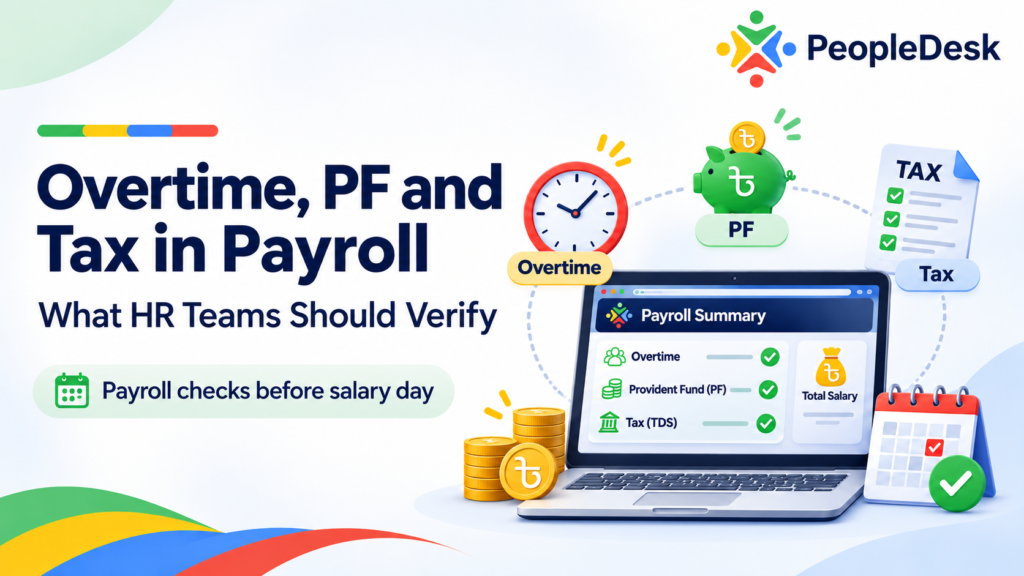
This is why overtime, PF and tax in payroll should not be treated as three separate month-end calculations.
They are connected payroll controls.
Before approving salary, HR and payroll teams should be able to answer three questions:
Was the employee paid for the correct time?
Were the correct PF deductions and contributions applied?
Was the correct employment and tax information used?
If answering those questions requires checking several spreadsheets, emails and manual files, the payroll process is already harder to control than it needs to be.
A similar issue appears when attendance, leave and overtime are reconciled only after the month closes. We covered that process in our guide on Attendance-to-Payroll Automation: Data Checks Before Salary Day.
Why Overtime, PF and Tax Need Separate Verification
Regular salary is usually predictable.
Overtime, PF and tax are more sensitive because their inputs can change during the month.
Overtime may depend on:
- assigned shift
- actual attendance
- approved additional hours
- attendance correction
- employee eligibility
- applicable company policy
PF may depend on:
- employee membership or eligibility
- effective date
- basic salary or defined contribution basis
- employee contribution
- employer contribution
- loan or settlement records
Tax may change because of:
- salary revision
- overtime
- bonus
- arrears
- allowances
- leave encashment
- employee tax information
- current tax rules
The calculation itself may be automated.
The inputs still need control.
1. Verify Overtime Against the Correct Shift
Overtime verification should start with the employee’s roster, not with the final overtime amount.
Suppose an employee’s normal shift ends at 5:00 PM and the attendance record shows a check-out at 8:00 PM.
That three-hour difference does not automatically prove that three hours should become payable overtime.
HR should first verify:
- which shift the employee was assigned
- whether the roster changed that day
- actual check-in and check-out
- whether the extra work was authorized
- whether any attendance adjustment was made
- which overtime rule applies
This becomes especially important in factories, retail operations, hospitals and businesses where employees frequently rotate between shifts.
If roster management itself is creating confusion, review the operational controls in Shift Roster Management for Multi-Location Teams before designing the payroll process.
Bangladesh law also makes overtime a control issue, not simply a calculation field. Section 108 of the Bangladesh Labour Act states that a worker covered by the provision who works beyond the prescribed hours is entitled to overtime allowance at twice the ordinary rate based on the wage components specified in the Act.
For HR, the practical point is straightforward:
Verify the employee, hours, wage basis and applicable rule before overtime reaches payroll.
2. Separate Worked Hours From Approved Overtime
One of the easiest ways to create payroll errors is to treat every extra attendance hour as payable overtime.
These are not necessarily the same thing.
A better process separates:
Actual Attendance → Overtime Calculation or Request → Approval → Payable Overtime
Consider an employee who remains at work for two hours after the scheduled shift.
The attendance device may correctly record those two hours.
But perhaps only one hour was authorized for operational work.
Payroll should consume the approved overtime value according to the organization’s applicable policy and legal requirements, rather than blindly using raw attendance duration.
This distinction also improves payroll traceability.
If an employee questions the overtime amount later, HR should be able to trace:
Attendance → Shift → Overtime Rule → Approval → Payroll
rather than manually reconstructing the decision from messages and spreadsheets.
3. Resolve Overtime Exceptions Before Payroll Cutoff
A payroll team should not discover unresolved attendance issues while generating salary.
The exceptions should already be visible.
Before payroll cutoff, review records such as:
- missing punches
- incorrect shifts
- roster changes
- pending overtime approval
- unusually high overtime
- rejected overtime
- manual attendance adjustment
- attendance updated after cutoff
The goal is not to inspect every employee manually.
The goal is to separate normal payroll records from exceptions.
For example:
Employee A: Correct shift, complete attendance, approved overtime.
Employee B: Six hours of overtime recorded, but approval is still pending.
Employee C: Worked night shift, but the roster still shows day shift.
Employee D: Attendance was manually changed after the monthly cutoff.
Employees B, C and D require review.
Employee A should move through payroll without unnecessary manual intervention.
That is a better use of automation.
4. Verify PF Eligibility Before Deduction
Provident fund should not be treated as a deduction that simply repeats because it appeared in the previous month’s payroll.
HR should know why an employee is included in the PF process.
Check:
- whether the employee is eligible
- membership or effective date
- applicable contribution basis
- employee contribution
- employer contribution
- any policy change during the month
Bangladesh’s current Labour Act framework contains specific provisions for provident funds in private-sector establishments. Section 264 covers the formation and administration of provident funds, contribution conditions and related requirements. The provision was also amended in 2026, including rules relating to participation in the Universal Pension Scheme in certain circumstances.
This is important for payroll teams because PF rules should not be based on an old spreadsheet or an assumed percentage.
The organization should confirm which legal and policy framework applies to its workforce.
5. Reconcile Employee and Employer PF Contributions
PF can affect more than one financial record.
The employee contribution may appear as a payroll deduction.
The employer contribution is a separate employer obligation.
Those two values need to remain distinguishable.
A basic reconciliation should connect:
Employee PF deduction → Employee PF record
and
Employer contribution → Employer/Fund obligation
Suppose payroll shows Tk 300,000 deducted for PF across employees for the month.
The payroll team should be able to reconcile that value with the corresponding PF records rather than assuming the payroll total is automatically correct.
Differences may come from:
- new members
- employee exits
- salary changes
- contribution adjustments
- PF loan transactions
- correction of previous periods
The earlier the variance is identified, the easier it is to resolve.
6. Review PF Carefully During Final Settlement
A normal salary run and an employee’s final settlement are not the same process.
When someone leaves the organization, HR may need to review:
- current salary
- unpaid salary components
- PF contribution
- employer contribution
- PF balance
- outstanding PF loan
- other loan or advance
- applicable settlement items
The Bangladesh Labour Act also protects qualifying provident-fund benefits in certain termination, retirement and separation situations.
From a system perspective, that is why PF should not exist as an isolated monthly deduction.
It should remain connected with the employee lifecycle and settlement process.
7. Verify the Tax Treatment of Payroll Components
Tax errors often happen because payroll components are created without a clear tax treatment.
HR may know that an employee receives:
- basic salary
- house-related allowance
- bonus
- overtime
- arrears
- leave encashment
- incentive
But payroll also needs to know how those components should be handled under the current tax framework.
The Income Tax Act, 2023 defines employment income broadly. Its definition of salary includes allowances, leave allowance, leave encashment, bonus, fees, commission and overtime, among other employment receipts.
This does not mean every payroll component should be handled identically.
It means salary-component configuration needs proper tax mapping.
For each component, HR and payroll should know:
What is the component?
Who receives it?
When does it apply?
How does it affect payroll?
How should it be treated for tax under the current rules?
That configuration should also have an owner.
Tax setup should never become a “configure once and forget forever” process.
8. Check Employee Tax Information Before Payroll
Correct rules can still produce the wrong result if employee information is incorrect.
Before salary processing, verify relevant employee tax data and any changes that occurred during the period.
Depending on the organization’s process, this may include:
- employee tax identification information
- applicable taxpayer category
- current taxable salary information
- previous deductions
- salary revisions
- bonus or arrear
- employment changes
The Income Tax Act also requires tax to be deducted from employment income using the applicable estimated income and average tax rate framework under Section 86.
For tax years 2026–27 and 2027–28, current NBR guidance lists the general tax-free income threshold for an individual taxpayer at Tk 375,000, with different thresholds for some taxpayer categories.
The important operational lesson is not the number itself.
It is this:
Payroll tax configuration must be reviewed against current NBR guidance when regulations change.
HR teams can use the National Board of Revenue Income Tax Publications and current NBR Income Tax Circulars as authoritative reference points when reviewing payroll tax configuration.
9. Run a Pre-Payroll Exception Review
The final control should bring overtime, PF and tax together.
Rather than reviewing the salary sheet employee by employee, HR should identify exceptions.
A useful pre-payroll review could answer:
- Who has unusually high overtime this month?
- Which overtime records are still pending approval?
- Which employees had shift changes?
- Which attendance records were manually corrected?
- Who became PF eligible?
- Who left the PF scheme or organization?
- Do PF deductions reconcile with contribution records?
- Who received salary revisions?
- Who received arrears or bonuses?
- Which employees show unusual tax changes?
- Are there unexpected zero or negative salary results?
- Which employees have a large net-pay variance from the previous month?
This is where payroll automation becomes useful.
Automation should reduce the number of routine records HR needs to inspect while making unusual records easier to identify.
A Practical Example
Consider an employee named Rahim.
During one payroll month:
- Rahim moves from a day shift to a rotating shift.
- He completes approved overtime.
- His salary is revised.
- He becomes eligible for PF.
- He receives a performance bonus.
Now imagine those changes are managed separately.
Operations sends overtime approval by email.
HR updates the shift in one file.
PF eligibility is kept in another spreadsheet.
Payroll manually enters the salary revision.
Tax is calculated from another worksheet.
The employee’s final salary might still be correct.
But proving why it is correct becomes difficult.
A more controlled flow would look like this:
Employee Record
→ Shift/Roster
→ Attendance
→ Approved Overtime
→ Salary Components
→ PF Eligibility
→ Tax Information
→ Payroll Calculation
→ Exception Review
→ Approval
→ Payslip / Bank Advice
If Rahim later asks why his net salary changed, HR has a clear path to investigate.
That is more important than simply generating payroll faster.
What HR Should Verify Before Approving Payroll
Before approving the monthly salary run, the reviewer should be able to trace unusual payroll components back to their source.
For overtime
Verify:
- correct shift
- actual attendance
- approved overtime
- applicable rule
- any manual correction
For PF
Verify:
- eligibility
- effective date
- contribution basis
- employee contribution
- employer contribution
- relevant loan or settlement adjustments
For tax
Verify:
- salary-component classification
- employee tax data
- salary changes
- bonuses and arrears
- current NBR rules
- unusual month-on-month differences
Then review the final payroll for exceptions before approval.
Do Not Confuse Payroll Automation With Payroll Control
A payroll system can calculate numbers quickly.
That does not guarantee the inputs are correct.
If the employee is assigned to the wrong shift, overtime automation can calculate the wrong amount faster.
If PF eligibility is outdated, an automated deduction can repeat the wrong deduction every month.
If a salary component has the wrong tax configuration, automation can scale that error across many employees.
So the objective should not be “maximum automation.”
It should be:
Reliable data + controlled rules + visible exceptions + clear approvals.
If your organization is still evaluating the wider HRMS requirements behind payroll, the HR Software Buying Guide for Bangladesh provides a broader checklist for attendance, payroll, HR operations and implementation planning.
How PeopleDesk Connects the Payroll Workflow
PeopleDesk brings employee records, attendance, shifts and rosters, overtime, leave, payroll, allowances and deductions, bonus, PF and other employee processes into a connected HR environment.
Its current product scope includes Attendance & Leave, Payroll & Compensation, Loan & PF Management, Approval Workflow, Employee Self-Service and Retirement & Final Settlement.
For payroll operations, this matters because the team can evaluate payroll inputs as part of the employee’s wider HR record rather than rebuilding the month from unrelated files.
For example, HR can work with a process such as:
Roster
→ Attendance
→ Overtime
→ Payroll Inputs
→ Payroll Review
→ Payslip
PeopleDesk’s verified payroll scope also includes salary setup, allowance, deduction, bonus, salary generation, payslip and bank-advice related processes.
You can review the full PeopleDesk HRMS and Payroll Management solution for the broader module structure.
The important point is that HR software should support the organization’s payroll controls.
It does not replace responsibility for configuring company policies, validating employee data or keeping statutory settings current.
What to Test During an HRMS Payroll Demo
Do not ask a vendor to demonstrate payroll using an employee with perfect attendance and a fixed salary.
That scenario is too easy.
Instead, create a difficult test case.
For example:
An employee changes shift halfway through the month, has an attendance correction, works approved overtime, receives a salary revision, becomes PF eligible and receives a bonus.
Then ask the vendor to show:
- Where did the shift information come from?
- How was attendance corrected?
- How was overtime approved?
- What amount became payroll input?
- How was PF applied?
- How were salary components handled?
- What changed in tax-related payroll information?
- Which exceptions were shown before payroll approval?
- Who approved the final payroll?
- Can the final payslip be traced back to those source records?
That test reveals far more about a payroll system than a polished dashboard.
Final Payroll Checklist
Before salary is released, HR should verify:
- employee master changes
- shift and roster changes
- attendance exceptions
- approved overtime
- leave and absence
- salary changes
- allowances and deductions
- bonus and arrears
- PF eligibility
- PF contributions
- tax-related employee data
- payroll exceptions
- final approvals
- payslip and payment totals
If these inputs are connected and reviewed before payroll closes, the team spends less time trying to explain salary differences after payment.
Frequently Asked Questions
What should HR verify before paying overtime?
HR should verify the employee’s assigned shift, actual attendance, overtime eligibility, applicable policy or legal rule, approval and any attendance correction before the overtime amount reaches payroll.
Should all extra attendance hours become overtime?
No. Extra attendance time and payable overtime should be treated as separate records. The payable amount should follow the organization’s approved policy and applicable law.
What PF information should HR verify?
HR should verify employee eligibility or membership, effective date, applicable contribution basis, employee contribution, employer contribution and any relevant loan, adjustment or settlement record.
What does Bangladesh law say about overtime?
For workers covered by Section 108 of the Bangladesh Labour Act, overtime beyond prescribed working hours is payable at twice the ordinary rate calculated using the wage components specified in the provision.
Is overtime considered employment income for tax purposes?
The Income Tax Act, 2023 includes overtime within its definition of salary for employment-income purposes.
What is the general tax-free income threshold for 2026–27?
Current NBR guidance lists Tk 375,000 as the general individual tax-free threshold for tax years 2026–27 and 2027–28. Different limits apply to specified taxpayer categories.
Can HR software eliminate payroll errors?
HR software can reduce manual handoffs and make payroll controls easier to manage, but it cannot correct inaccurate source data automatically. Shift, attendance, overtime, PF, salary and tax information still need proper configuration and review.
What should HR test during a payroll software demo?
Use an employee scenario with real exceptions: shift changes, attendance correction, overtime, salary revision, PF, bonus and tax impact. Ask the vendor to trace the case from source record to final payslip.