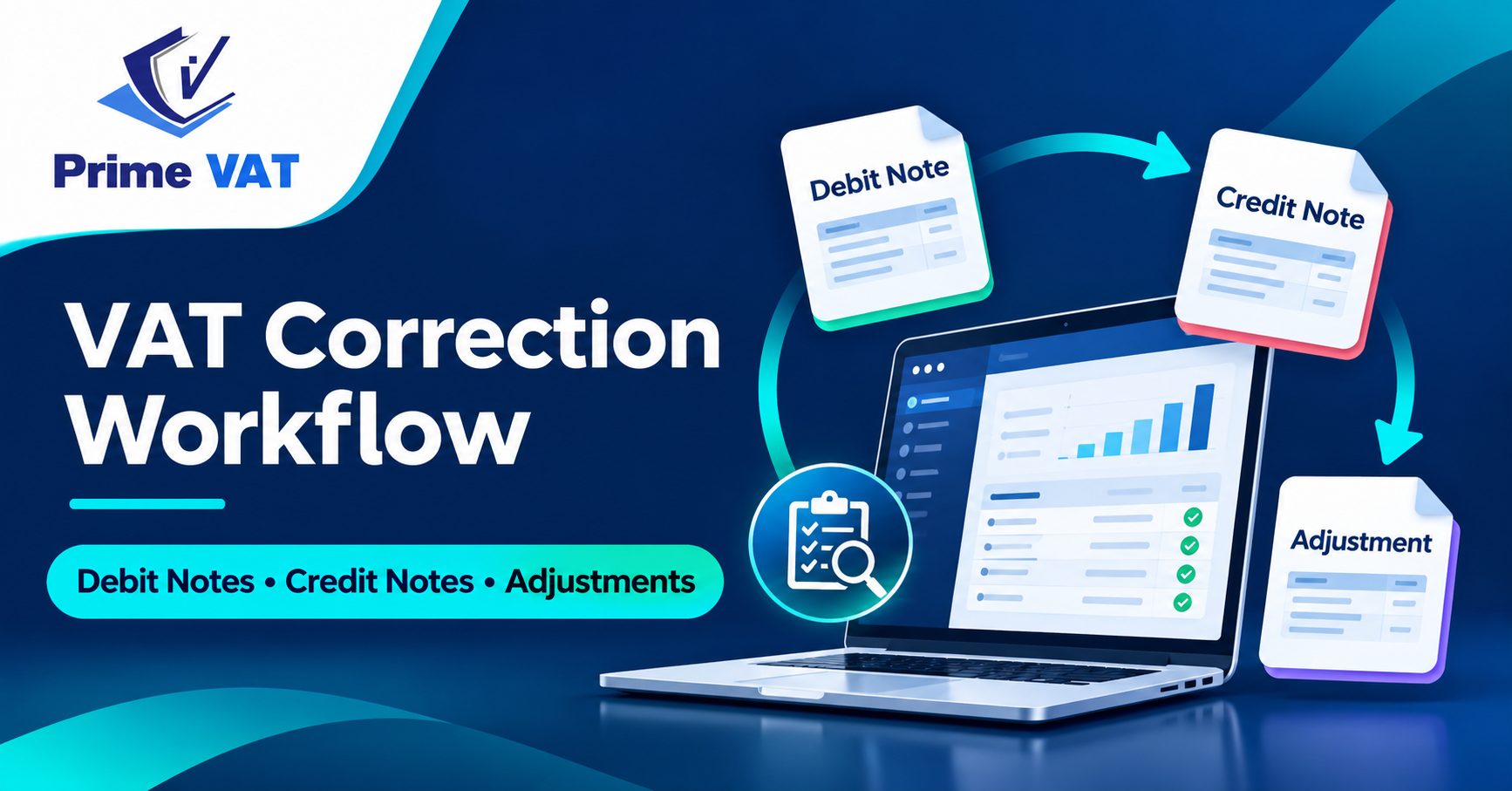
A VAT correction workflow in software should let finance teams correct a posted VAT-related transaction without erasing the original record, losing the document reference, or creating another disconnected spreadsheet.
For VAT, finance, accounts and compliance teams in Bangladesh, the practical question is not only whether the software has a debit note, credit note or adjustment screen. The real question is whether the correction remains connected to the original transaction, the reason for change, the reporting period and the final register or report.
PrimeVAT by AKIJ iBOS is built as a dedicated VAT management and recordkeeping solution for Bangladesh businesses. Its product structure includes purchase and sales records, debit and credit notes, VAT adjustments, VDS, branch-level operations, treasury-related records and VAT reporting. But before looking at any product, it helps to understand what a controlled correction workflow should actually do.
Why VAT Correction Workflows Become Difficult After Posting
Before a transaction is finalized, correcting an entry can be relatively straightforward.
The problem starts when a purchase, sales invoice or other VAT-related record has already been posted, reviewed or used in reconciliation.
Imagine a sales invoice was posted on Monday. On Wednesday, part of the value needs to be corrected. If the original invoice is simply overwritten, finance may lose the record of what was originally posted. If the correction is maintained in a separate Excel file, the original transaction and correction can become disconnected.
That creates several risks:
- the original reference becomes difficult to trace;
- two teams may correct the same issue differently;
- the correction may fall into the wrong reporting period;
- branch and head-office records may no longer match;
- finance may struggle to explain the final VAT position during review.
A good VAT correction workflow in software therefore treats correction as a controlled continuation of the original transaction, not as a replacement for it.
Debit Note vs Credit Note vs VAT Adjustment
One important distinction needs to be clear before designing the workflow.
Under Bangladesh VAT Rules, credit notes and debit notes are supplementary documents linked to previously issued invoices. The NBR framework identifies VAT-6.7 as the credit note and VAT-6.8 as the debit note. In the statutory framing, a credit note is associated with a decreasing adjustment, while a debit note is associated with an increasing adjustment.
Operational software may organize these records within purchase, sales or adjustment modules depending on the product design. That product structure should not be confused with the legal definition.
The official NBR VAT Online Service Center is the appropriate reference point for current VAT services, rules and related guidance.
| Correction record | Practical purpose in a software workflow | What should remain connected | What finance should be able to review |
|---|---|---|---|
| Debit note | Record an applicable increasing correction linked to an earlier transaction | Original document, counterparty, reason, amount and date | Original value, correction value and reporting impact |
| Credit note | Record an applicable decreasing correction linked to an earlier transaction | Original invoice/document, counterparty, reason, amount and date | Original value, correction value and reporting impact |
| VAT adjustment | Record another VAT-related adjustment that requires a controlled reference and reason | Related transaction, VDS or supporting reference | Basis, period, amount and effect on VAT reporting |
This distinction matters because a vat credit note debit note process should not become three unrelated screens with no connection to the original transaction.
1. Decide Whether the Source Record Is Still a Draft
The first control in a VAT correction workflow is simple:
Can the original transaction still be corrected as a draft, or has it already become part of the formal transaction trail?
If an entry is still genuinely in draft status and has not yet flowed into the relevant review or reporting process, correcting the draft may be the appropriate operational action.
Once the transaction has been finalized or posted, the safer control is generally to preserve that original record and create the appropriate correction record rather than silently replacing history.
This is important because finance may later need to answer:
- What was originally recorded?
- What changed?
- Why was it changed?
- Who made the correction?
- Which period did the correction affect?
- What did the final report show?
A correction workflow that cannot answer those questions is difficult to audit internally even if the final number happens to be correct.
2. Keep Every Correction Linked to the Original Transaction
Traceability is the core control.
A VAT correction workflow in software should let the reviewer move through a clear sequence:
Original transaction → Correction record → Review → Register/report impact
For a debit note or credit note, that means keeping the original invoice or transaction reference available.
For an adjustment, the software should retain the business reason and the source document or VAT-related reference that explains why the adjustment exists.
At minimum, the record should make it possible to identify:
- original document reference;
- business unit or branch;
- customer or supplier where relevant;
- correction date;
- posting or reporting period;
- correction reason;
- correction value;
- user or status information;
- downstream reporting effect.
Without these links, month-end review becomes a reconstruction exercise.
3. Use a Controlled Debit Note Workflow
A debit note workflow should not begin with creating a new standalone number and then asking finance to remember what it relates to.
The workflow should start from the source transaction or a clearly referenced original document.
A practical process might look like this:
- Identify the original transaction.
- Confirm why an increasing correction is required.
- Create the debit note with the original reference.
- Record the relevant value and reason.
- Review the reporting period.
- Confirm how the change appears in the applicable register or VAT report.
In PrimeVAT’s product structure, debit-note functionality is associated with purchase operations. That is a product workflow design. The statutory VAT treatment should still be determined from the applicable NBR requirements and the actual transaction.
The important software test is whether the debit note preserves the link to the earlier record instead of creating an unexplained adjustment.
4. Use a Controlled Credit Note Workflow
The same principle applies to a credit note.
A credit note should remain attached to the transaction it is correcting.
For example, if a previously recorded sales transaction later requires a decreasing correction, finance should be able to see both the original record and the credit note rather than seeing only a reduced final total.
A controlled credit note workflow should retain:
- the original transaction reference;
- customer or relevant counterparty;
- correction reason;
- correction amount;
- date and period;
- user action or status;
- the effect on the related reporting view.
In PrimeVAT’s current product structure, credit-note functionality sits within sales operations. Again, that describes how the software organizes the workflow, not a substitute for the statutory definition.
5. Handle VAT Adjustments With the Same Reference Discipline
VAT adjustments can become the weakest part of the process if teams treat them as free-text journals.
A useful VAT adjustment should answer three questions immediately:
What is being adjusted? Why? Against which reference?
PrimeVAT’s verified scope includes credit/debit-related adjustments, VDS adjustments and other VAT adjustment operations.
For finance teams, the practical control is to make sure the adjustment carries enough context to explain its effect later.
This becomes especially important for VDS-related records. If the operational transaction exists in the VAT system but the VDS correction is maintained separately, month-end reconciliation can become unnecessarily difficult.
Before finalizing an adjustment, finance should check:
- whether the supporting reference exists;
- whether the reason is specific;
- whether the reporting period is correct;
- whether another team has already corrected the same issue;
- whether the adjustment remains visible in the appropriate reporting view.
6. Connect Correction Records to Branch and ERP Data
Correction workflows become more difficult in multi-branch organizations.
A branch may identify the issue first, while head office VAT or finance teams may need to review the correction and its reporting impact centrally.
The system therefore needs to preserve branch or business-unit identity.
A consolidated total is not enough if the finance team cannot trace the correction back to the branch transaction that caused it.
The same principle applies when operational data comes from an ERP or another business system.
PrimeVAT supports integration and data feeds for items, partners, purchases, sales, transfers and production data. This can reduce repetitive entry, but integration does not remove the need for finance review.
The correction still needs to answer:
- Which source transaction came from the business system?
- What was changed inside the VAT workflow?
- Was the correction entered in the correct period?
- Can the source record and corrected VAT record still be reconciled?
The value of integration is not simply moving data faster. It is maintaining a cleaner transaction trail between operational records and VAT records.
7. Check the Reporting Effect Before Month-End
A correction is not complete simply because a debit note, credit note or adjustment has been saved.
Finance needs to understand how that correction appears later.
A strong VAT correction workflow in software should keep the correction visible in the relevant transaction review, register or reporting process.
The reviewer should not have to compare multiple spreadsheets to understand the final position.
| Original situation | Correction record | What should remain visible | Month-end control |
|---|---|---|---|
| Earlier transaction requires an increasing correction | Debit note | Original record plus linked correction | Confirm amount, reference and reporting period |
| Earlier transaction requires a decreasing correction | Credit note | Original record plus linked correction | Confirm amount, reference and reporting period |
| VDS or another VAT-related position requires adjustment | VAT adjustment | Supporting reference, reason and adjusted value | Confirm basis and period |
| Branch-level transaction requires correction | Linked correction/adjustment | Branch identity plus central visibility | Confirm the correction is not duplicated elsewhere |
Before month-end or Mushak-related preparation, finance should make sure that corrections have not disappeared into net totals.
The aim is to be able to explain the path from source transaction to final reported position.
Two Practical VAT Correction Examples
Example 1: An Earlier Transaction Needs an Increasing Correction
Assume an earlier transaction has already been recorded and later a valid additional value needs to be recognized.
Instead of overwriting the original transaction, the VAT team identifies the source document and creates the applicable debit note.
The correction retains the earlier reference, reason, date and amount.
Finance then reviews the reporting period and confirms how both the original record and the correction appear in the relevant register or report.
The final number is important, but the visible history is equally important.
Example 2: A Previously Recorded Value Needs to Be Reduced
Now assume an earlier invoice or VAT-related transaction requires a valid decreasing correction.
The team should not simply edit the historical value after the fact.
The applicable credit note is created with a reference to the original record.
The reviewer can then see:
Original transaction → Credit note → Corrected value → Reporting effect
That is the difference between a correction workflow and a replacement workflow.
How PrimeVAT Supports VAT Correction Workflows
PrimeVAT is a VAT management and recordkeeping solution developed by AKIJ iBOS for businesses operating in Bangladesh.
Its verified transaction and adjustment scope includes purchase entries, sales invoices, debit notes, credit notes, VAT adjustments, VDS, treasury-related records, branch transfers and VAT reports.
It can operate as a VAT system and can also connect with ERP or other business systems through supported API and data-feed workflows.
For organizations evaluating vat software in bangladesh, the useful question is not simply whether the software has debit note and credit note menus.
Ask whether the system helps your team keep:
- source transactions;
- correction records;
- branch context;
- VAT adjustments;
- reporting impact;
- and transaction history
connected in one operational process.
You can review the PrimeVAT VAT software solution to see how its VAT management scope fits into your existing finance and operational workflow.
VAT Correction Workflow Checklist for Finance Teams
Before approving a correction process, test whether your system can answer these questions:
- Can the team distinguish a draft correction from a post-posting correction?
- Does every formal correction retain the original document reference?
- Can finance see the reason and value of the correction?
- Is branch or business-unit identity preserved?
- Can debit notes, credit notes and adjustments remain visible during reporting review?
- Can ERP-fed source data still be traced after a VAT correction?
- Can finance identify duplicate or out-of-period corrections before month-end?
- Can the final reported position be traced back to the source transaction?
If those answers are unclear, the problem is not only data entry. It is correction control.
FAQ
What is the difference between a debit note and a credit note in Bangladesh VAT workflows?
Under the Bangladesh VAT Rules, both are supplementary documents connected to previously issued invoices. A debit note is associated with an increasing adjustment, while a credit note is associated with a decreasing adjustment. The applicable document and treatment should be determined from the actual transaction and current NBR requirements.
Should a posted VAT transaction simply be edited when something changes?
A posted or finalized record should not normally be silently overwritten if doing so removes the original transaction history. A controlled correction process should preserve the original record and link the applicable correction to it.
What should VAT correction software keep for audit and reconciliation?
At minimum, finance should be able to identify the original reference, correction record, reason, amount, date or period, branch or business unit where relevant, user/status information and reporting impact.
Can VAT correction workflows work across multiple branches?
Yes, provided the system preserves branch-level transaction identity while allowing central VAT or finance teams to review the correction and consolidated impact.
Does ERP integration remove the need to review debit notes and credit notes?
No. Integration can reduce repeated data entry and improve source-data continuity, but finance still needs to validate the reference, reason, timing and reporting effect of the correction.
How should VAT adjustments appear during Mushak-related preparation?
They should remain visible and reference-based rather than disappearing into an unexplained net total. Finance should be able to understand why the adjustment exists, which record it relates to and which period it affects.
Build a VAT Correction Trail You Can Explain
The strongest VAT correction workflow in software is not the one with the most correction screens.
It is the one that lets finance explain what happened from beginning to end:
Original transaction → Correction → Review → Reporting impact
When debit notes, credit notes, VDS-related adjustments and other corrections stay connected to their source records, reconciliation becomes easier to manage and the final VAT position becomes easier to explain.
For Bangladesh VAT teams, that traceability should be tested before choosing or configuring any VAT management system.