ERP to VAT API Integration: Data Flow and Reconciliation
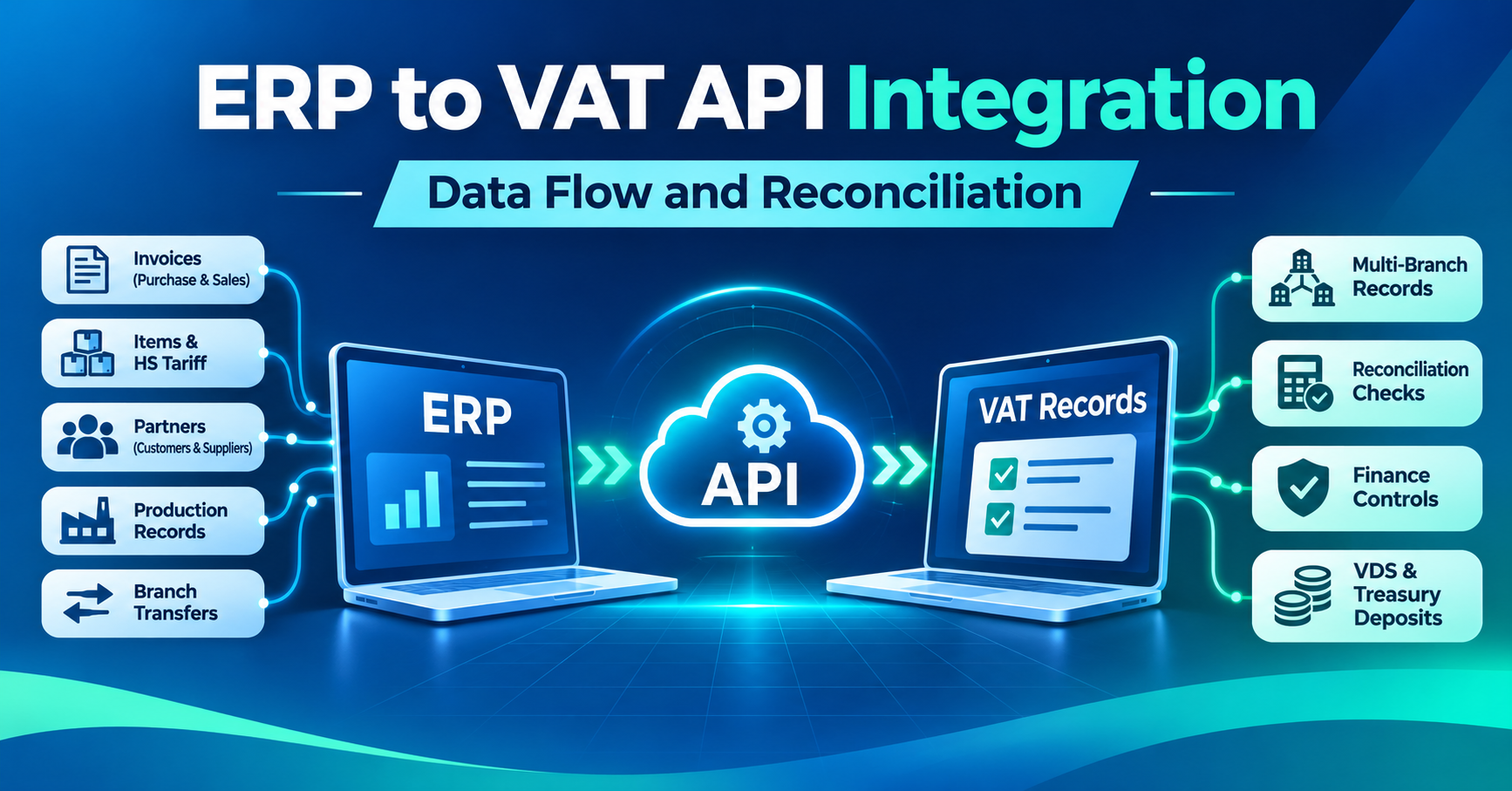
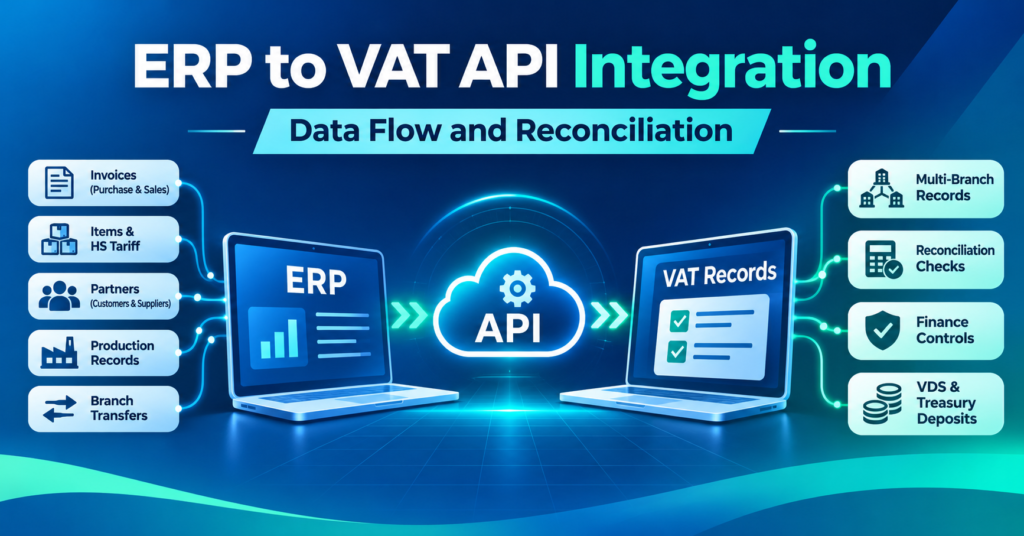
ERP to VAT API integration should move only the records that help finance build complete, traceable VAT registers. The integration works when item, partner, purchase, sales, transfer, and production data reach the VAT system cleanly, while finance still reviews VDS, treasury deposits, adjustments, and reporting status before Mushak preparation.
Many Bangladesh businesses already have the source transactions in ERP or operational systems, but the VAT team still rebuilds the same story in separate sheets, registers, and review files. That month-end disconnect between source activity and VAT records is exactly what makes purchase, sales, inventory, and treasury review harder before filing (VAT Transaction Workflow Software Bangladesh).
Why businesses connect ERP or business systems with VAT software
Businesses connect ERP or business systems with VAT software to reduce repetitive data handling and keep VAT records closer to the original transaction. ERP to VAT integration matters most when purchases, sales, branch activity, or production already exist in another system but VAT reporting still depends on separate re-entry.
The operational pain is familiar. Item data lives in one place, suppliers in another, branch transfers in email, VDS support in Excel, and month-end VAT review happens in a rush. Finance then spends time chasing document references instead of reviewing whether the VAT treatment is complete and supportable.
The broader problem is not only data entry. The broader problem is record organization, traceability, and reconciliation across branches, document types, and reporting periods, which is why businesses evaluating a better process often start with a practical guide to VAT management software in Bangladesh.
What data should flow from ERP to VAT software
What data should flow from ERP to VAT software depends on VAT recordkeeping needs, not on what is easiest to push technically. The safest design separates master data from transaction data, then defines which finance-reviewed VAT records stay under controlled handling inside the VAT process.
| Record type | Should it flow from ERP/business system? | Why VAT needs it | What finance must validate | |, -|, -|, -|, -| | Item master, HS tariff, UOM, price | Yes | Creates consistent item identity and VAT context | Item code, HS tariff mapping, UOM, active status | | Customer and supplier profiles | Yes | Keeps document history traceable by partner | Partner code, branch/entity identity, profile completeness | | Purchase entries and debit notes | Yes | Supports purchase register and correction history | Date, number, supplier, branch, values, reference links | | Sales invoices and credit notes | Yes | Supports output VAT and return/correction tracking | Invoice reference, customer, branch, values, linked note | | Branch transfers | Yes | Preserves inter-branch movement history | Sending branch, receiving branch, date, quantity, reference | | Production and contract manufacturing data | Yes, where relevant | Supports manufacturing-related VAT records | Input/output consistency, site or branch, item linkage | | VDS, treasury deposits, VAT adjustments | Controlled review first | Affects final reporting and supporting evidence | Status, supporting document, period, reviewer approval |
Item master, HS tariff, UOM, and price configuration
Item setup should flow before live transactions start. Customer supplier item master data for VAT becomes unreliable when item codes, HS tariff setup, UOM, or price logic differ between systems.
Finance should treat this as control data, not background setup. If one system posts the same item in cartons and the VAT system expects pieces, quantity and value review becomes harder before the first purchase register is even checked.
Customer and supplier profiles
Customer and supplier profiles should flow because VAT records are not only about values; they are also about document traceability. Customer supplier item master data for VAT must let finance see which supplier issued a purchase, which customer received a sales invoice, and which partner sits behind a VDS or note history.
At minimum, the mapping should preserve partner identity consistently across branches and document types. A valid invoice with a weak partner link is still a weak VAT record.
Purchase entries and debit notes
Purchase-side data should flow with the document references that let finance trace the record back to source. Purchase and sales data integration for VAT should include purchase number, date, supplier, branch, item lines, quantities, taxable value, VAT amount, and any debit note reference.
Debit notes matter because corrections should not become standalone numbers in month-end review. Finance needs to see what changed, when it changed, and which original purchase the correction belongs to.
Sales invoices and credit notes
Sales data should flow at invoice level, not only as period totals. Purchase and sales data integration for VAT is more useful when each sales invoice carries branch, customer, item, quantity, taxable value, VAT amount, and the source reference needed for follow-up.
Credit notes should stay linked to the original sales invoice. If a return or price correction reaches the VAT system without that link, finance may see the value movement but lose the business reason behind it.
Branch transfer records
Branch transfer records should flow because inter-branch stock movement affects how distributed businesses explain quantity and timing. Branch transfer and production data for VAT needs document identity, sending branch, receiving branch, item lines, and transaction date.
Without that context, head office may see stock movement in ERP but fail to explain the VAT record path by branch. That is where month-end reconciliation slows down.
Production and contract manufacturing data
Production and contract manufacturing data should flow where the business relies on manufacturing records to support VAT operations. Branch transfer and production data for VAT is especially important when raw materials, finished goods, and production output need to stay connected for review.
The point is not to turn VAT software into ERP. The point is to give the VAT team a traceable production-linked record, so finance is not rebuilding manufacturing support from scratch at return time.
VAT adjustments, VDS, and treasury-related records
VAT adjustments, VDS, and treasury-related records should not be pushed blindly just because some supporting data exists upstream. VDS and treasury deposit reconciliation usually depends on timing, status, evidence, and finance review, not only on amount fields.
A practical rule is simple: source data can inform these records, but reporting-impacting entries should stay under controlled review until finance confirms the period, document support, and adjustment logic.
What should not flow blindly in ERP-to-VAT API integration
Not every valid ERP transaction should post directly into VAT reporting. ERP to VAT API integration should reduce repetitive entry, not bypass review, approvals, draft handling, or exception control.
The records that should not flow blindly are usually the ones that change reporting risk fastest:
- unapproved or incomplete source transactions
- documents with missing item, partner, or branch mapping
- canceled or reversed records without clear reference to the original
- backdated corrections that can change a closed review period
- VDS, treasury, and adjustment records without full supporting evidence
A safer design places those transactions into draft or exception review instead of treating every incoming record as report-ready.
What finance must reconcile after integration
Finance must reconcile the records after integration because the sync itself does not prove reporting readiness. ERP VAT reconciliation means checking completeness, mapping, status, duplicates, values, correction links, and support for VDS or treasury entries before Mushak work starts.
| Reconciliation check | Source to compare | Owner | When to check | Common exception | |, -|, -|, -|, -|, -| | Completeness | ERP posted activity vs VAT register by type and branch | Finance/VAT | Daily or pre-close | Posted source record missing in VAT system | | Mapping | Master data and tax setup vs VAT record mapping | Finance + master-data owner | Setup and ongoing changes | New item, partner, or branch not mapped | | Status | Workflow status vs report-ready status | Finance/VAT reviewer | Before reporting | Draft documents mixed into totals | | Duplicate/missing control | Source reference vs VAT reference | Finance/VAT | Daily exception review | Repeat push or broken reference | | Value match | Source document values vs VAT values | Finance | Before month-end close | Rounding, partial return, wrong note impact | | VDS/treasury | Support docs and deposit evidence vs VAT entry | Finance/VAT | During month and pre-filing | Late certificate or missing deposit record | | Notes/adjustments | Original document vs note or adjustment record | Finance/VAT | At correction and month-end | Orphan debit/credit note |
Completeness check: did every expected transaction arrive?
Completeness is the first ERP VAT reconciliation test. Finance should compare posted source activity by document type, branch, and date against what the VAT system received.
Missing records are more dangerous than visible errors because they disappear quietly. A branch may believe a purchase or sales invoice was posted, while VAT review never sees it.
Mapping check: item, partner, branch, and VAT code alignment
Mapping is where technically successful integrations still fail finance. Customer supplier item master data for VAT must remain aligned across item, partner, branch, UOM, and VAT-related setup.
A transaction can arrive on time and still be unusable if the branch is wrong, the item is unmapped, or the partner profile is incomplete. Finance should treat mapping exceptions as report blockers.
Status check: draft, posted, adjusted, canceled, or rejected
Status matters because presence is not the same as readiness. ERP VAT reconciliation should tell finance whether a record is still in draft, already posted, later adjusted, canceled, or rejected from review.
This matters even more when selected transactions follow draft workflows. Month-end control should count only the records that are both received and in the right status for reporting.
Duplicate and missing document control
Duplicate control depends on stable reference logic. Finance should compare source document numbers and references against VAT-side document identities so repeat pushes and broken links appear quickly.
Missing-reference cases deserve the same attention as duplicates. A note, transfer, or production record without a valid source link will slow reconciliation later.
Value check: taxable value, VAT amount, and note adjustments
Value checks answer a simple question: did the taxable value and VAT amount arrive as expected? ERP VAT reconciliation should compare line and document totals, not only grand totals at period end.
Finance should also test how debit notes, credit notes, or adjustments change the final value. A correct original invoice can still lead to a wrong reporting position if the correction logic is incomplete.
VDS and treasury deposit reconciliation
VDS and treasury deposit reconciliation requires both numbers and evidence. Finance should check withheld amount, related document, applicable period, and supporting treasury or deposit record before final reporting.
Late certificates, timing mismatch, or branch-level ownership confusion often create problems here. An amount that exists without support is still an unresolved VAT item.
Debit note, credit note, and VAT adjustment reconciliation
Correction records must point back to the original transaction. ERP VAT reconciliation is weaker when debit notes, credit notes, or VAT adjustments sit as isolated entries without document lineage.
Finance should confirm the original reference, reason for change, period effect, and revised value. That keeps correction history understandable during internal review and later audit follow-up.
A simple example shows why this matters. A manufacturer sends item and partner master data from ERP to the VAT system, posts a local purchase at the Dhaka branch, transfers finished goods to the Chattogram branch, issues a sales invoice there, and then raises a credit note for a return. Finance should be able to confirm that all four records arrived, landed under the right branches, kept the right values, and that the credit note still points to the original sales invoice rather than appearing as a free-standing reduction.
Controls for multi-branch VAT data integration
Multi-branch VAT data integration works only when every record carries clear business-unit and branch identity. Central visibility helps finance only if the sending branch, receiving branch, sales center, and document timing are preserved consistently.
Head office should be able to review branch-level purchases, sales, transfers, notes, and exceptions from one place without losing the original ownership of the transaction. A useful next step for distributed businesses is a branch-focused multi-branch VAT control checklist.
A practical ERP-to-VAT API integration checklist for finance, VAT, and IT
A practical rollout starts with scope and controls before it starts with endpoints. ERP to VAT API integration should go live only after finance, VAT, and IT agree what will flow, who reviews exceptions, and when reconciliation will happen.
- Define document scope first. Decide which master and transaction records will flow in phase one.
- Clean master data before sync. Fix item, partner, branch, HS tariff, and UOM mismatches early.
- Set reference and mapping rules. Agree the source keys that will identify purchases, sales, transfers, and corrections.
- Design exception handling. Decide which records should go to draft, review, or rejection queues.
- Test month-end scenarios. Test purchase, sales, branch transfer, note correction, VDS timing, and closed-period cases.
- Assign close ownership. Finance, VAT, and IT should know who checks completeness, values, and failures each period.
Before filing, teams should also confirm that integration review is complete, because portal work is the last step, not the first step, in the month-end process (eVAT Filing Preparation Checklist Bangladesh).
Where PrimeVAT fits in the process
PrimeVAT fits as the dedicated VAT management and recordkeeping layer between source transactions and VAT reporting. PrimeVAT can operate independently or connect with ERP or other business systems so relevant data reaches a centralized VAT process.
PrimeVAT is built to manage VAT records such as item and HS tariff setup, UOM and price configuration, customer and supplier profiles, purchase entries, sales invoices, debit notes, credit notes, production and contract manufacturing records, branch transfers, destruction and wastage records, VAT adjustments, VDS, treasury deposits, opening balances, and VAT reports and registers. PrimeVAT can integrate with ERP or other business systems through API and supported data feeds for items, partners, purchases, sales, transfers, and production data, while selected transactions such as purchase, sales, and treasury entries can follow draft workflows for controlled review. The public PrimeVAT product page also positions the solution around keeping VAT records organized from purchases and sales through VDS and treasury deposits.
Final takeaway: connected data helps, but finance control still closes the loop
ERP to VAT API integration improves record flow, but finance control still closes the loop. The best design moves the right source data into VAT operations, then applies disciplined reconciliation before Mushak preparation, especially around branch routing, document status, correction links, VDS, and treasury evidence.
That is the real standard for a useful integration: not maximum data movement, but better traceability, fewer repeated entries, and clearer ownership at month-end.
What is ERP to VAT API integration?
ERP to VAT API integration is the controlled transfer of relevant ERP or business-system data into VAT software. The goal is not to copy every field. The goal is to bring the records finance needs for VAT traceability, such as items, partners, purchases, sales, transfers, and production data, into one VAT process before reporting.
What data should flow from ERP to VAT software?
The best candidates are item master data, HS tariff and UOM setup, customer and supplier profiles, purchases, sales invoices, branch transfers, and production-related records where relevant. VDS, treasury deposits, and VAT adjustments usually need tighter review because the amount alone is not enough; status, period, and supporting evidence also matter.
Does ERP to VAT API integration remove the need for reconciliation?
No. ERP to VAT API integration reduces repetitive data handling, but finance still needs to reconcile completeness, mapping, status, duplicate control, values, and correction links. A record can arrive successfully and still be unfit for reporting if the branch is wrong, the source link is missing, or a note is not tied to the original transaction.
How should multi-branch businesses handle ERP to VAT integration?
Multi-branch businesses should treat branch identity as a core control field, not as optional metadata. Every purchase, sales invoice, transfer, and correction should carry the correct business unit and branch reference. Head office should then review exceptions centrally while preserving local ownership of the original transaction and support documents.